
2025年 3月29日(日)国際シンポジウム「アニメの表皮、原画・セルの肉体〜アニメ中間素材の将来性をめぐって」開催のお知らせ
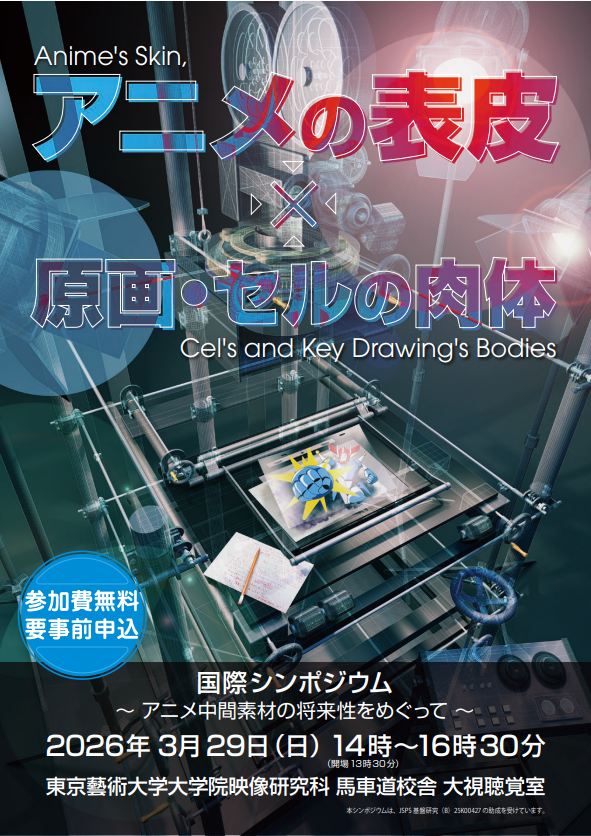
国際シンポジウム「アニメの表皮、原画・セルの肉体〜アニメ中間素材の将来性をめぐって」開催のお知らせ
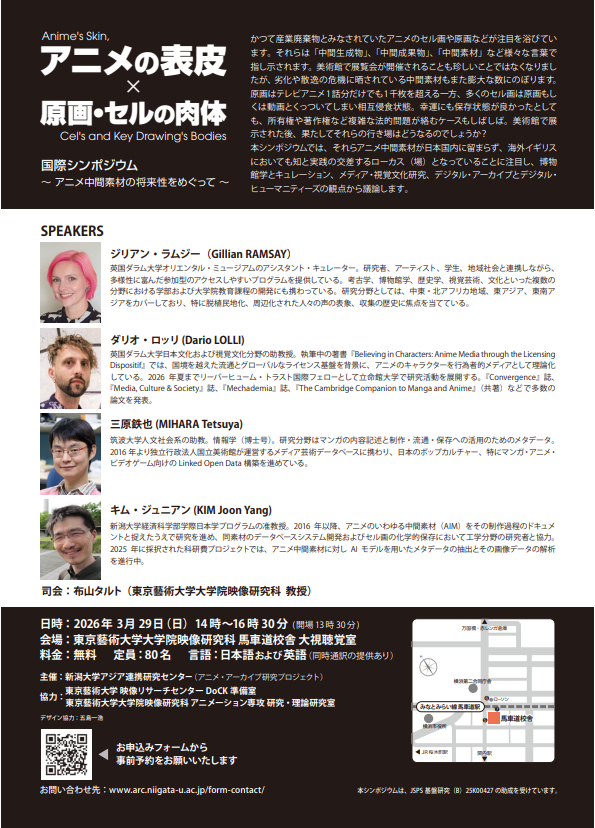
・日時:2026年3月29日(日)14時〜16時30分(開場13時30分)
・場所:東京藝術大学大学院映像研究科 馬車道校舎 大視聴覚室
〒231-0005神奈川県横浜市中区本町4-44
横浜高速鉄道みなとみらい線 馬車道駅下車 5・7出口よりすぐ
※アクセス情報:https://www.geidai.ac.jp/access/yokohama
・料金:無料 定員:80名
・言語:日本語および英語(同時通訳の提供あり)
【参加申込】以下のお申込みフォームから事前予約をお願いいたします。
https://forms.gle/pNESUBrR5qQRqsxA7
【チラシ】0329国際シンポジウム ※下記掲載チラシのPDFがダウンロードできます。
PROGRAM & SPEAKERS
- 冒頭報告:キム・ジュニアン(新潟大学)
- ジリアン・ラムジー(ダラム大学オリエンタル・ミュージアム)
- 三原鉄也(筑波大学)
- ダリオ・ロッリ(ダラム大学)
【休憩】
- ディスカッション
※司会:布山タルト(東京藝術大学大学院)
・主催:新潟大学アジア連携研究センター(アニメ・アーカイブ研究プロジェクト)
https://www.arc.niigata-u.ac.jp/research/anime-archive/
・協力:東京藝術大学 映像リサーチセンターDoCK 準備室
東京藝術大学大学院映像研究科アニメーション専攻研究・理論研究室
・デザイン協力:五島一浩
・お問い合わせ先:www.arc.niigata-u.ac.jp/form-contact/
※本シンポジウムは、JSPS基盤研究(B)25K00427の助成を受けています。
*************発表概要*************
キム・ジュニアン(KIM Joon Yang)
概要(冒頭報告):
1970年代からアニメ業界で長年スタッフとして活動した渡部英雄氏は、現役時代に収集・保存し、教育現場でも活用した絵コンテや原画など膨大な数の「中間素材」を新潟大学に一任し、それらのアーカイブ化と共に調査、研究、展示活動が行われてきた。このような活動を通して見えてきたアニメの中間素材を取り巻く3つの課題を提出しつつ、アカデミアに可能な研究方法として、メディア理論家のレフ・マノヴィッチが提唱する「文化解析」の見地から、META社のAIモデルLlamaを用いたうえで1,078枚の原画アーカイブに対し行ったキャラクター表情の時系列パターン解析の一部を紹介する。
Abstract:
Countless “intermediate” materials, like storyboards and key frame drawings, rendered in the anime industry have been archived, investigated, researched, and exhibited at Niigata University, which working in the industry from the 1970s, Mr. Watanabe Hideo collected, conserved, and utilized for students in class. On the basis of such research activities, this paper addresses three issues of the intermediate materials, and introduce part of the analytics of the temporal patterns of anime characters’ facial expressions, with Llama, META’s AI model employed, on 1,078 sheets of archived key frame drawings, in terms of the media theorist Lev Manovich’s Cultural Analytics.
ジリアン・ラムジー(Gillian RAMSAY)
発表概要:
ダラム大学オリエンタル・ミュージアムは、2011年に日本コレクションの戦略的見直しを行った後、アニメのセル画や関連商品を含むエフェメラ(一時的資料)、工芸品、現代美術の収集に特に重点を置いたうえで、収集対象の時代を拡大するプロジェクトに着手した。本発表では、イングランド北東部在住の日本人コミュニティーの方々の支援による初期の収集から、ダイナミックな教育ツールとしての現在の役割に至るまで、コレクションの変遷を辿る。また、博物館による保管状況と改善計画の最新の見直しを概観し、それらの資料がもたらす保存上の課題を提出する。最終的に本発表は博物館にとって、アニメのセル画は日本の伝統を現代のクリエイティブ産業へとつなぐことを可能にする他に類を見ない強力なキュレーション・ツールであり、観覧者が日本文化に深く関わるための、アクセスしやすく魅力的な入り口になり得ると主張する。
Abstract:
Following a strategic review of the Japanese collections in 2011, the Oriental Museum, Durham University undertook a project to broaden the temporal remit of the collection, with a particular focus on collecting contemporary art, craft and ephemera including anime cels and related merchandise. This paper traces the evolution of the collection, from its initial formation supported by members of the Japanese community living in the northeast of England to its current role as a dynamic teaching tool. It also addresses the conservation challenges posed by this material, outlining the museum’s current review of storage conditions and planned improvements. Ultimately, the paper argues that anime cels offer a uniquely powerful curatorial tool, allowing museums to bridge Japan’s historical traditions with its contemporary creative industries, while providing an accessible and compelling gateway for audiences to engage more deeply with Japanese culture.
三原鉄也(MIHARA Tetsuya)
発表概要:
本発表者は、ここ10年間、メタデータ技術やデジタルアーカイブの専門家として文化庁が行うマンガ・アニメをはじめとするメディア芸術の資料のアーカイブ構築に関する事業に関わってきた。近年は、その活動で得た知見を元に、手描きアニメの中間成果物を対象に動きを構成する複数の原画および動画のデジタル化画像をアニメーションとして再生する機能を持つデジタルアーカイブシステムの構築と制作過程に即して資料間の関係を記述するグラフデータベース(Knowledge Graph)の構築を行ってきた。これらはデジタルアーカイブのための国際的な標準技術・ツールを活用して構築されたものである。本発表では、文化庁のメディア芸術のアーカイブについての取組と共に、本発表者が開発中のこれらのシステムについて紹介する。
Abstract:
The presenter has been involved for the past decade in projects by the Agency for Cultural Affairs, Japan to build archives for materials of Media Arts, including manga and anime, as an expert in metadata technology and digital archiving. In recent years, drawing on insights gained from these activities, the presenter has developed a digital archiving system specifically targeting intermediate production materials of hand-drawn animation. The crucial function of the system is to play digitized images of multiple key and inbetween drawings that compose motion as animation. Concurrently, a graph database (Knowledge Graph) has been constructed to describe relationships between materials for the trace of the production process. These systems were built using international standard technologies and tools for digital archives. The presentation will introduce the Agency for Cultural Affairs’ initiatives regarding Media Arts archives alongside the system currently under development by the presenter.
ダリオ・ロッリ(Dario LOLLI)
発表概要:
1980年代初頭、イタリアのメディアを通して、アニメは高度なコンピュータによって制作された可能性があるという考えがある程度広まっていた。日本が半導体生産で世界をリードしていた当時、宮崎駿と協力関係を持っていたマルコ・パゴットによるアニメのセルバンクについての発言が、ある種の強力なコンピュータ・ツールを指していると思ったイタリアのジャーナリストたちによって誤解された可能性がある。それから40年以上経った今、アニメが他のあらゆる生産分野と同様に自動化されているかもしれないという考えは、驚くべきことではなく、多くのアニメーターにとって日常の現実となっている。しかし、アニメの自動化はAIによって始まったわけではない。それは既にセル・アニメーションの時代に仮想的なレベルで体現された傾向であった。本発表は、アニメの過去を時代遅れとして片付けるのではなく、古い中間素材やセルバンクというレンズを通してAIとアニメーションの関係を検証することを提案する。それらのモノは、自動化されたアニメ制作における連続性と相違を浮き彫りにすることで、現代の不気味なメディア考古学を掘り出す。果たして生成AIは、アニメスタジオの拡張版のように機能するのだろうか?もしそうだとしたら、私たちはますます中割りアニメーターに似てきているのではないだろうか?この場合、私たちはどのような「アニメ」が作りたいのかが、重要な問いかもしれない。
Abstract:
In the early 1980s, the idea that anime could have been created by advanced computers somehow spread through Italian media. At a time when Japan was a world leader in semiconductor production, statements by Miyazaki Hayao’s collaborator Marco Pagot regarding anime cel banks were likely misinterpreted by journalists, who thought he was referring to some sort of powerful computational tool. More than 40 years later, the idea that anime may be, like any other productive field, automated, is not only hardly surprising but a lived reality for many animators. Yet, the automation of anime did not start with AI: it was already a virtual tendency embodied in cel animation. Rather than dismissing anime’s past as obsolete, I thus propose to examine the relation between AI and animation through the lens of old intermediate materials and cel banks. By highlighting continuities and differences in automated anime production, these objects unearth an uncanny media archaeology of the present. Is it possible that, after all, Gen AI may be acting like an extended anime studio? If so, are we not increasingly resembling inbetween animators? If this is the case, the main question may well be what kind of “anime” we want to produce.